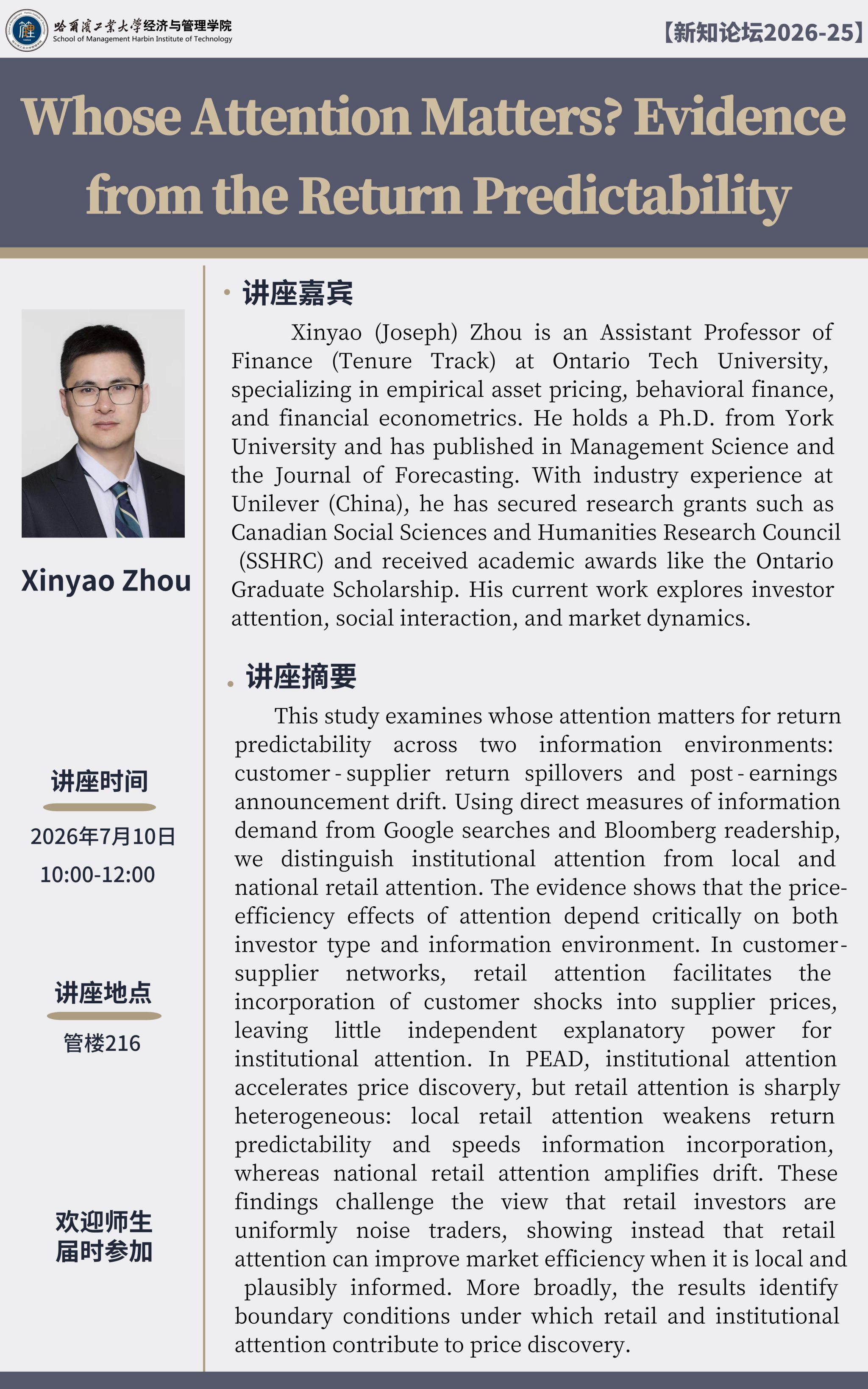
讲座时间:2026年7月10日10:00
讲座地点:管楼G216
讲座主题:Whose Attention Matters? Evidence from the Return Predictability
讲座嘉宾简介
Xinyao (Joseph) Zhou is an Assistant Professor of Finance (Tenure Track) at Ontario Tech University, specializing in empirical asset pricing, behavioral finance, and financial econometrics. He holds a Ph.D. from York University and has published in Management Science and the Journal of Forecasting. With industry experience at Unilever (China), he has secured research grants such as Canadian Social Sciences and Humanities Research Council (SSHRC) and received academic awards like the Ontario Graduate Scholarship. His current work explores investor attention, social interaction, and market dynamics.
讲座摘要
This study examines whose attention matters for return predictability across two information environments: customer-supplier return spillovers and post-earnings announcement drift. Using direct measures of information demand from Google searches and Bloomberg readership, we distinguish institutional attention from local and national retail attention. The evidence shows that the price-efficiency effects of attention depend critically on both investor type and information environment. In customer-supplier networks, retail attention facilitates the incorporation of customer shocks into supplier prices, leaving little independent explanatory power for institutional attention. In PEAD, institutional attention accelerates price discovery, but retail attention is sharply heterogeneous: local retail attention weakens return predictability and speeds information incorporation, whereas national retail attention amplifies drift. These findings challenge the view that retail investors are uniformly noise traders, showing instead that retail attention can improve market efficiency when it is local and plausibly informed. More broadly, the results identify boundary conditions under which retail and institutional attention contribute to price discovery.